
What is Loan Management System?
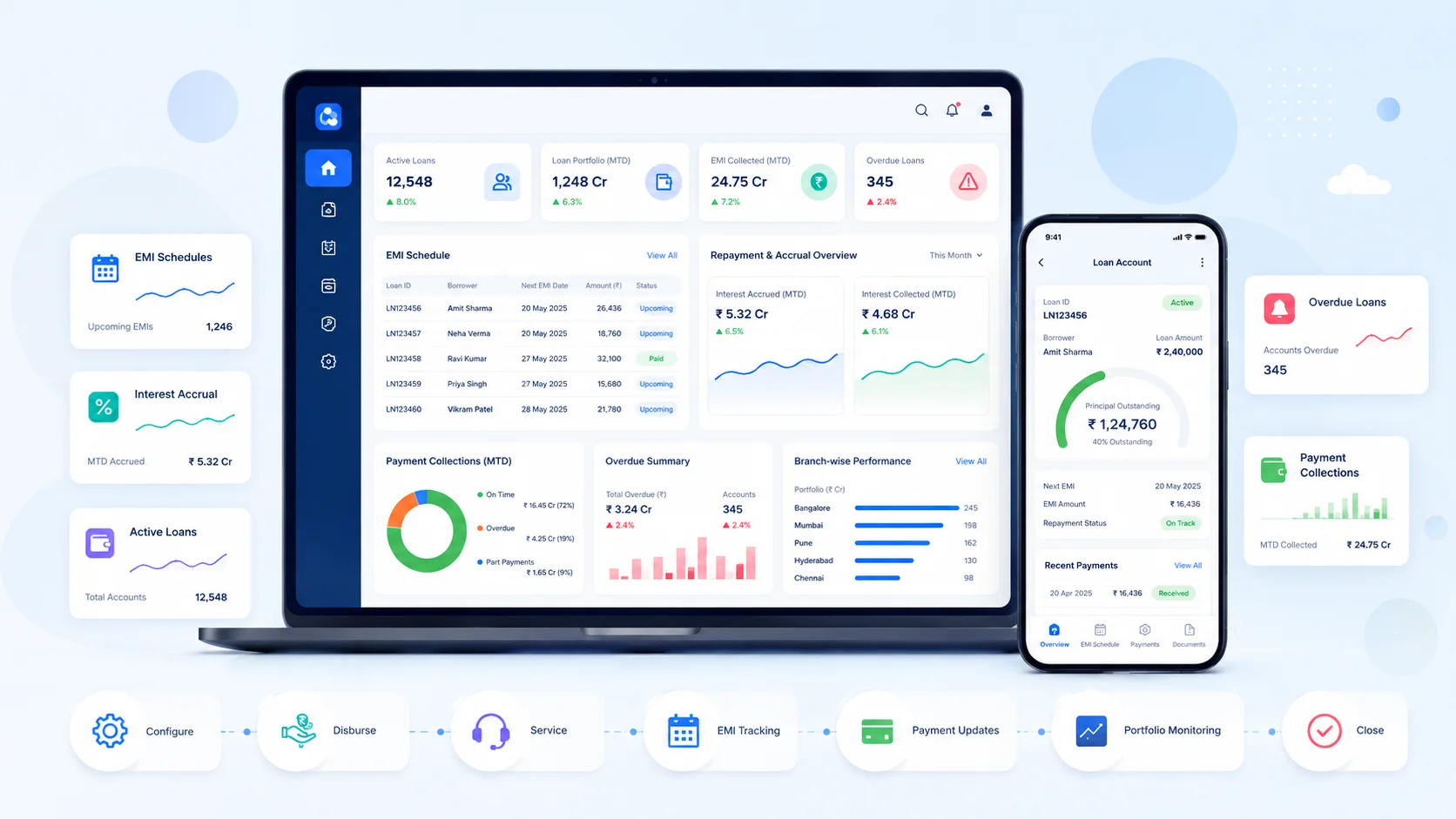
A loan management system (LMS) is software that manages a loan after it's disbursed — tracking EMI schedules, interest accrual, and repayment status in real time.
See common questions


A loan management system (LMS) is software that manages a loan after it's disbursed — tracking EMI schedules, interest accrual, and repayment status in real time. Finsta's LMS replaces manual repayment registers and spreadsheet-based ledgers with an automated system that updates every time a payment is made. Lenders using Finsta's LMS get a live, accurate view of every active loan across every branch.
Selected institutions using Finsta
















A loan management system (LMS) is software that manages a loan after it's disbursed — tracking EMI schedules, interest accrual, and repayment status in real time.
See common questionsA loan management system takes over the moment a loan is disbursed. It's the engine that runs a loan for its entire active life, until it's fully repaid or closed.
It sits between origination and collections — receiving approved loans from an LOS and making repayment/overdue information available for collection follow-up.
Core functions of an LMS:
These two systems are often confused because they sound similar, but they manage opposite ends of a loan's life.
| Factor | Loan Management System (LMS) | Loan Origination System (LOS) |
|---|---|---|
| Stage covered | Post-disbursal: servicing an active loan | Pre-disbursal: application to approval |
| Core job | Track repayment of a loan already issued | Decide whether to lend |
| Key outputs | EMI schedule, interest accrual, repayment ledger | Credit score, approval/rejection, sanction letter |
| Typical users | Servicing and accounts teams | Credit and underwriting teams |
If you're looking for the system that handles applications before disbursal, see our Loan Origination System page.
Manual loan servicing — repayment registers, spreadsheet ledgers, phone-based EMI reminders — breaks down as loan volume grows. Errors in interest calculation or missed overdue flags directly hurt asset quality.
A dedicated lending management software keeps every loan's ledger accurate automatically, and surfaces overdue accounts the moment they slip, instead of days or weeks later.
| Without an LMS | With Finsta's Loan Management System |
|---|---|
| Manual repayment registers | Automated EMI and repayment tracking |
| Spreadsheet-based interest calculation | System-calculated interest accrual |
| Delayed overdue detection | Real-time overdue flagging |
| Branch-by-branch reporting | Consolidated, live portfolio dashboard |
Finsta's loan management system takes over the moment the Loan Origination System approves and disburses a loan.
Disbursed loan details flow in automatically, with EMI schedules generated based on tenure and interest terms.
Interest accrues and ledgers update automatically as each billing cycle passes.
Payments are posted in real time, whether collected digitally, in-branch, or through a field agent.
Every loan's full transaction history also feeds the Integrated Financial Management System for accounting and audit reporting.
Finsta's LMS is built for the operational realities of Indian lending institutions, not adapted from a generic global platform.
What sets it apart:
Finsta's loan management system is used across:
Servicing logic is configured differently by loan type — see how it applies to Gold Loans, Vehicle Loans, Business Loans, and other loan types on our NBFC Software page.
Finsta's LMS is the servicing core of a five-part NBFC software suite — receiving loans from origination, and feeding both collections and accounting as a loan runs its course.
See the full platform on our NBFC Software page, or explore the connected modules:
Finsta's Loan Management System keeps every active loan accurate and up to date, with overdue accounts flagged the moment they slip.
Clear answers to common questions about this Finsta solution, its workflows and where it fits in the lending lifecycle.
A loan management system (LMS) is software that manages a loan after it has been disbursed — tracking EMI schedules, interest accrual, and repayment status. It automates the servicing stage of lending, replacing manual repayment registers with a system that updates in real time as payments are made.
A Loan Management System (LMS) manages a loan after disbursal, tracking repayments and interest. A Loan Origination System (LOS) manages the application before disbursal, handling credit scoring and approval decisions. The two cover opposite ends of a loan's lifecycle within the same lending platform.
Yes. A loan management system flags an account the moment a due date is missed, rather than relying on manual review. Finsta's LMS passes overdue accounts directly to its Loan Collection System, so recovery action can begin immediately instead of after a delayed manual check.
Yes. Interest accrual is a core function of a loan management system. It calculates interest based on each loan's specific terms — reducing balance, flat rate, or other structures — and updates the ledger automatically each billing cycle, removing manual calculation errors.
Yes. A configurable loan management system applies different servicing rules for each loan type, since repayment structures vary — for example, gold loans often use bullet repayment while business loans use EMIs. Finsta's LMS supports gold, vehicle, personal, business, and other loan types within one platform.
Yes. A loan management system scales from single-branch operations to large multi-branch networks. Finsta's LMS provides a consolidated, live portfolio view for head office, so loan performance across every branch is visible without waiting on manual branch-level reports.
Yes, in a connected platform. Finsta's LMS feeds every transaction into its Integrated Financial Management System for accounting, and automatically flags overdue accounts to its Loan Collection System — so servicing data flows through the loan lifecycle without manual re-entry between systems.
Book a guided demo based on your institution type, branches, lending products and required modules.